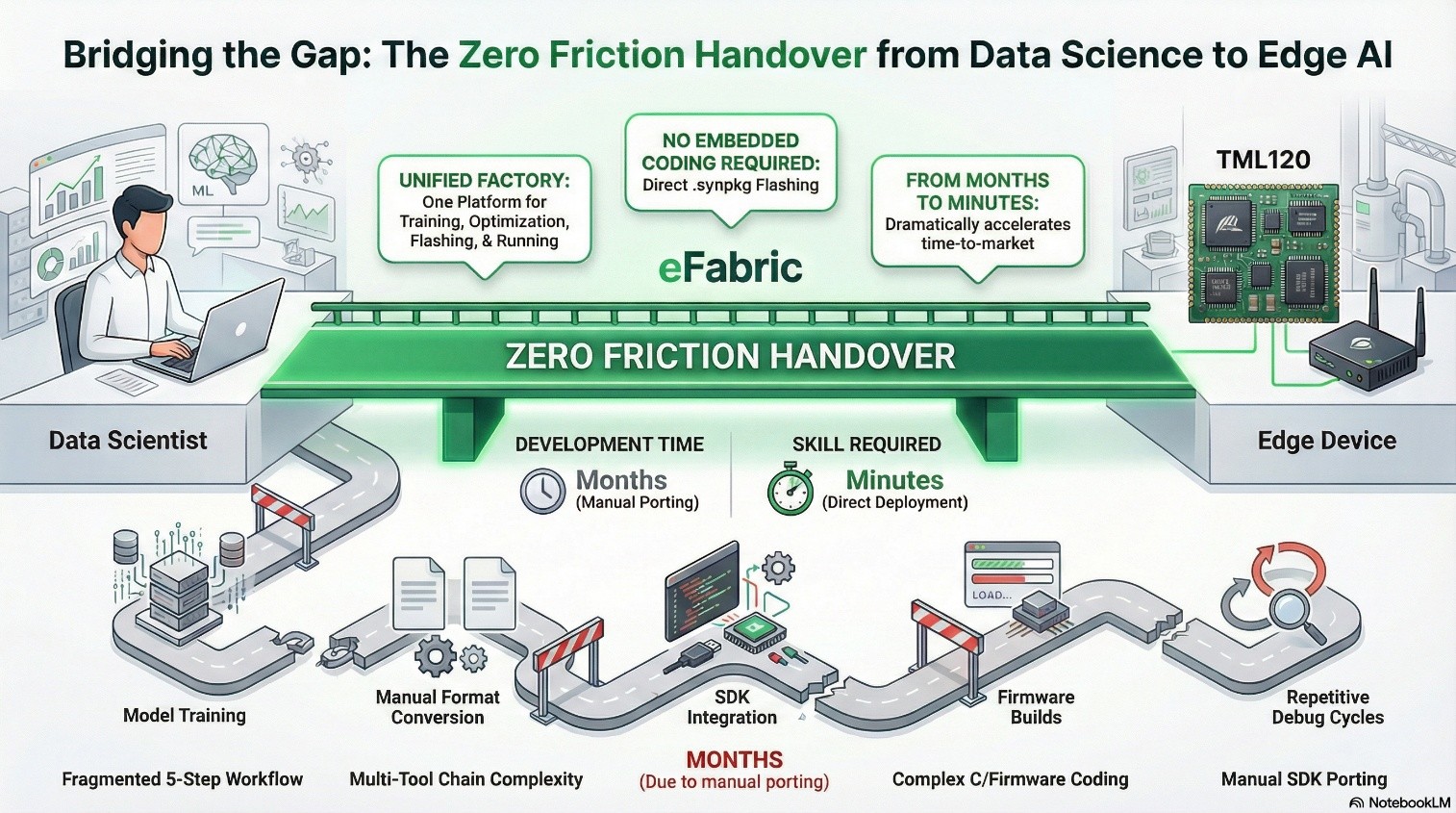
Bridging the Professional Divide
Traditionally, a massive gap exists between Data Science and Embedded Firmware Engineering.
- Data scientists work in high-level environments like Python and Jupyter.
- Embedded engineers work in low-level C/C++ with hardware-specific SDKs.
Data Science vs. Embedded Firmware Engineering
In a typical workflow, a model developed by a data scientist must be manually "ported" or rewritten by an embedded engineer to fit the constraints of a specific chip. This transition is often where projects stall due to memory limitations, power consumption issues or coding errors during the porting process.
The "Zero-Friction" Handover Concept
eFabric™ acts as the ultimate bridge. By providing a unified interface, it enables a "Zero-Friction Handover". The platform automatically handles the "translation" of high-level AI models into silicon-ready binaries. This means the same platform used to train the model is also used to deploy it, ensuring that the performance seen during validation is exactly what you get on the hardware.
Low-Code / No-Code for Rapid Prototyping
As a low-code/no-code platform, eFabric™ empowers software developers and product managers to build and deploy hardware-ready models without needing deep expertise in hardware-level firmware coding. This accelerates time-to-market by allowing teams to iterate on ideas in minutes, not months.