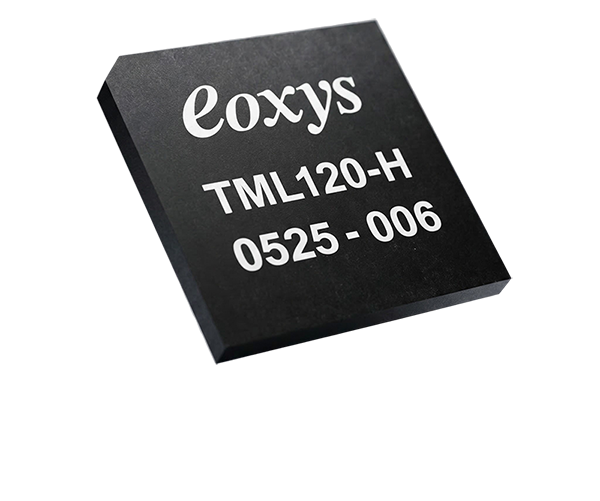
TML120 MODULE
TML120 is a XENO+ Series Tiny ML Module which is a solderable module and is used for building Audio as well as Sensor data-based Edge AI enabled IoT devices for applications such as medical, industrial and many other edge AI enabled vertical domains. The TML120 module integrates the ML Processor (i.e Neural Decision Processor) for easy/ ready to use design approach that brings together AI and deep learning capabilities and thus unlocking unparalleled opportunities for innovation in the IoT ecosystem. With TML120, the customers can accelerate their product development with the
freedom to focus solely on adding audio or sensor circuits and their unique value proposition, customers can expedite their product development while ensuring optimal security and performance. The TML120 offers factory level flashing through PC Flashing tool or eFabric platform via serial programming UART interface pins of the module. Other than this programming UART interface, there is a host processor serial UART interface which sends ML classification event messages to host processor. The customers can use this programming UART to configure and flash the binaries required for the TML120 module at lab/ factory level. This reduces significant amount of Embedded SW development effort. The TM120 module internally manages below list of points without the host processor intervention:
- Provides user programming option to the Users at factory level through serial UART interface and works with the PC Flashing tool.
- Saves ML Processor’s configuration and initialization parameters internally via the PC Flashing tool.
- Downloading of binary files via the PC Flashing tool and eFabric platform.
- Reporting of ML Classification events to the host processor via serial host UART interface.
This ML Processor can run multiple Audio and Sensor data ML applications simultaneously with minimal power consumption. The ML Processor is designed to natively run multiple Deep Neural Networks (DNN) on a variety of architectures, such as CNNs, RNNs and fully connected networks up to 256 layers. The ML Processor below audio and sensor interfaces are available at the solderable module pins and can be configured via PC flashing tool by the users.
- Audio-0 (AUD0) port can be configured to work with PDM Mics for running Audio ML classification ap plications using this module.
- Audio-1 (AUD1) can be configured with PDM/ I2S/ TDM Input Mics.
- Audio-2 (AUD2) can be configured with I2S/ TDM Output.
- I2C can be configured with any sensors for time-series data ML classification requirements.